Skip to content
Rewiring Aotearoa Download PDF
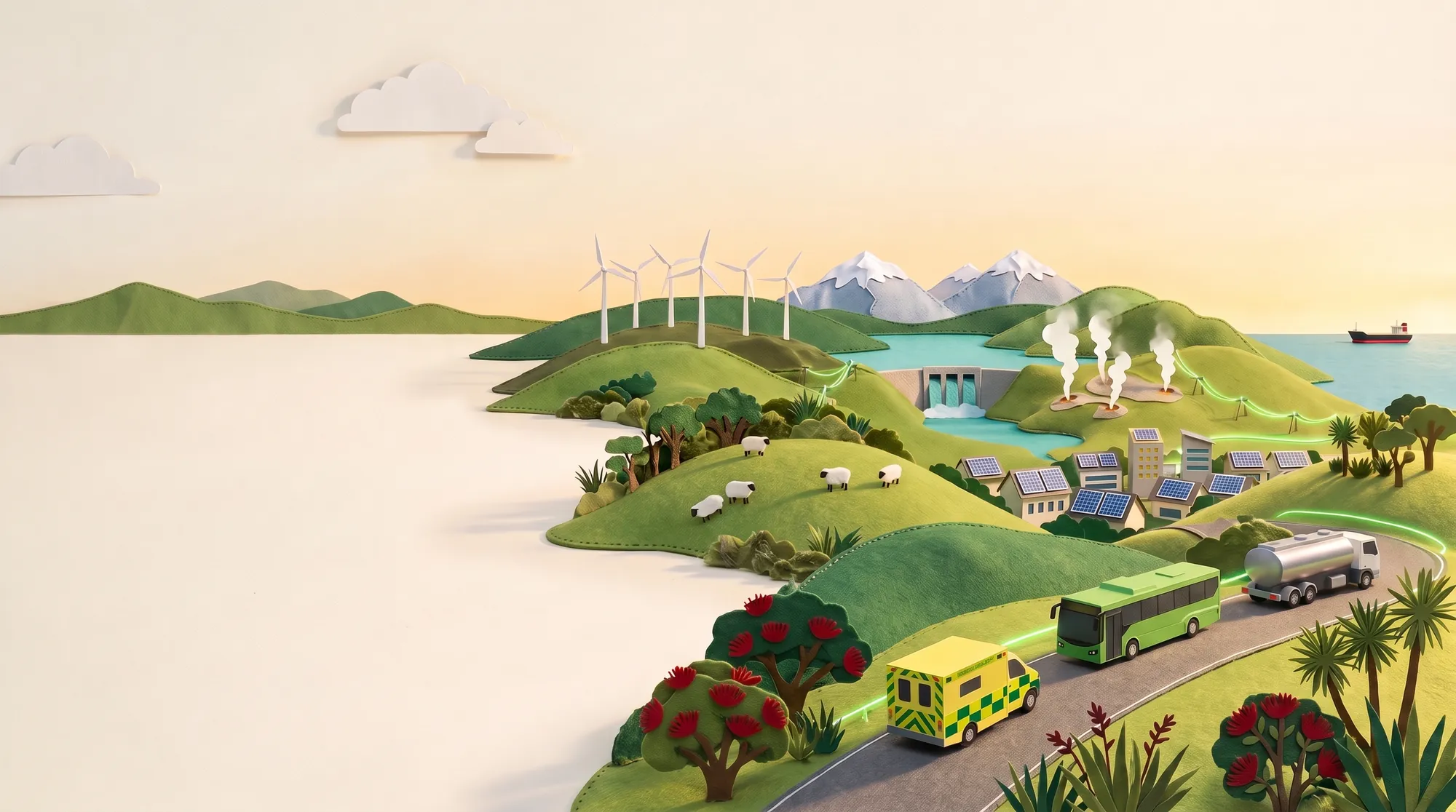
Felt and cut-paper diorama of a New Zealand town at golden hour: homes with solar roofs, an electric ambulance and electric bus on a winding road, geothermal steam, hills and mountains behind, and a lone fuel tanker far out at sea.

Powered from Within

New Zealand-made energy is New Zealand security. Our 2026 thinkpiece is a costed plan to keep hospitals, freight and food running through fuel shocks.

  • $40m a day spent on fuel
  • $29m a day saved by 2040 if we electrify our homes
  • $10b a year sent overseas
  • 25-30 days of fuel in the country
  • 0 public heavy-truck chargers in New Zealand

This is a rare moment of clarity.

Essentially all our petrol, diesel and jet fuel arrives by ship, 10 to 20 days away. We have had no refinery since Marsden Point closed in 2022.

Our isolation is usually an asset. In a fuel emergency it becomes a critical liability. The good news: the fix exists today, and it saves money shock or no shock.

The question is not whether another disruption will come, it is whether we will have acted before it does.

p.1

The daily fuel bill

New Zealand spends $40 million every day on imported fuel.

At roughly $40 million a day in normal conditions, and more than $60 million a day during recent shocks p.2

Felt and paper diorama of a red fuel tanker sailing away from a small New Zealand coastal town, with a trail of banknotes streaming off the water and into the sky behind it.
$29m a daysaved by 2040 with full electrification of our homes and household machines p.2
$10b a yearsent overseas for every year we wait p.2

Countries spend fortunes on security they hope never to use. This is security that pays for itself whether the crisis comes or not.

Spend once, save forever.

It's already running on our roads, roofs and water. It costs more upfront, then pays back for decades.

  • 5-7 yearsHospital solar payback

    Then 20 years of free energy. p.2

    Based on Rewiring Aotearoa illustrative modelling for Waikato Hospital, p.19

  • 5-7 yearsSchool solar payback

    A standard 30 kW school system saves up to $8,000 a year. p.20

  • <1/3the running cost of its diesel twin

    Ports of Auckland's Sparky: the world's first full-size electric ship-handling tug. p.2

  • Tens of thousandsof dollars saved over an EV's lifetime

    Run it on New Zealand-made energy and the savings stay here. p.2

The rest of the world is already acting.

Nations facing our exact vulnerability have made electrification their security strategy.

  • A superpower treats electrification as security.

    About 80% of its oil imports pass through one strait it doesn't control. Its strongest answer: EVs, batteries and renewables. p.14

    China

  • Russian gas cut from 45% to 12%.

    In three years under REPowerEU. Russian oil fell from 27% to 2%, and Russian coal to zero. p.14

    European Union

  • Solar hospitals kept working through blackouts.

    Distributed solar and batteries proved harder to destroy and faster to fix. 22 major installations serve 1.5 million people. p.14

    Ukraine

  • From 94% imported oil to wind power.

    Hit by the 1973 oil embargo, it never let up. Wind now supplies close to half its electricity. p.13

    Denmark

Seven pillars. One plan.

From fire trucks and hospitals to how Treasury counts risk. Each pillar protects us in a shock and saves money if none comes.

  1. Pillar 1: Electrify Crown-owned assets$700m-1.0b
  2. Pillar 2: Local government and public transport$500m-800m
  3. Pillar 3: Critical private infrastructure$600m-900m
  4. Pillar 4: Essential workers' personal transport$300m-500m
  5. Pillar 5: Food production and distribution$300m-500m
  6. Pillar 6: Charging infrastructure$400m-600m
  7. Pillar 7: Value fuel security properly<$10m

Pillar 1: Electrify Crown-owned assets

Electrify the police cars, fire trucks, hospitals and schools government already owns.

$700m-1.0b from the ten-year fund p.65

Felt and paper diorama of a hospital and a school with solar roofs and a glowing battery unit beside them, with an electric fire truck and police car on the road out front.

Government replaces vehicles, boilers and generators all the time, with money already budgeted. A fossil replacement locks in ten to twenty more years of imported fuel. An electric one removes it for good, at little or no extra capital cost.

  • Police's own BMW i4 electric patrol cars have, in Police's words, exceeded expectations. p.16
  • Christchurch Airport runs the Southern Hemisphere's first airport electric fire truck. p.17
The asks for Pillar 1, 4 items
  • Electric by default. Every government vehicle and machine replacement is electric unless no viable option exists.

    p.16
  • Police and Fire. Police passenger fleet 80% electric by 2030; Fire light vehicles all electric by 2028.

    p.16-17
  • Hospitals. Solar and batteries at the 20 largest hospitals by 2028, the other ~60 by 2031.

    p.18
  • Schools. Bigger solar, batteries as standard, and heat pumps replacing coal and diesel boilers.

    p.21

Full detail in the PDF, p.16-21

Pillar 2: Local government and public transport

Buses, halls, water plants and rubbish trucks: what keeps a town going in a fuel shock.

$500m-800m from the ten-year fund p.65

Felt and paper diorama of an electric bus at a stop, a community hall with solar panels, an electric rubbish truck, and a water treatment plant beside a river.

Every electric bus running full serves the same passengers as dozens of private cars.

p.24

Councils run the assets communities lean on in an emergency. Electrify the fleets and put solar and batteries on the halls, so each can run without grid power or fuel.

  • Shenzhen electrified all 16,359 of its buses by 2017. Energy use fell about 73% and ridership rose. p.24
  • In Cyclone Gabrielle, Te Karaka Area School sheltered 400 to 500 residents: 'the school as the town base'. p.26
The asks for Pillar 2, 4 items
  • A hub for every town. One resilience hub for every community of 2,000+, off-grid for 72 hours.

    p.25
  • Electric buses. A Public Transport Electrification Fund to take electric buses national.

    p.24
  • Water. 48 to 72 hours of solar and battery backup at major water plants.

    p.27
  • Shared cost. A Local Government Resilience Fund, so ratepayers don't carry it alone.

    p.27

Full detail in the PDF, p.24-27

Pillar 3: Critical private infrastructure

Ambulances, supermarket trucks, cell towers, ports and milk tankers. Privately run, nationally essential.

$600m-900m from the ten-year fund p.65

1/4as much to run as a diesel ambulance. London reports about £2,100 a year electric vs £8,100 diesel. p.29
Felt and paper diorama of an electric ambulance on a country road, a milk tanker beside a dairy farm, a delivery truck at a distribution shed, and port cranes and ships behind.

Many services we need most in a shock aren't Crown-owned. Government still holds the levers: it funds 75-80% of ambulance services and can co-invest in freight, ports and cell sites.

  • Australasia's first electric emergency ambulance is on 12-hour urban shifts in Hamilton. p.29
  • Foodstuffs' electric truck runs Palmerston North to Wellington six days a week, refrigeration included. p.31
  • Only two cell towers were damaged in Cyclone Gabrielle. About 80% of outages came from lost power. p.32
The asks for Pillar 3, 4 items
  • Ambulances. New ambulances zero-emission from 2026; urban fleets by 2032, rural by 2035.

    p.29
  • Grocery trucks. Half of distribution-centre-to-store trucks electric by 2029, backed by a dedicated grant.

    p.30
  • Cell sites. A 72-hour backup standard for cell sites, including 24 hours of battery.

    p.32
  • Ports. Electrify container handlers, tugs and shore power at the six major ports.

    p.33

Full detail in the PDF, p.29-33

Pillar 4: Essential workers' personal transport

A solar-powered hospital is no use if the nurses can't fuel their cars to get there.

$300m-500m from the ten-year fund p.65

Felt and paper diorama at night of a health worker in scrubs plugging an electric car into a charger outside a modest house, with an apartment block and another charging car next door.

Nurses, paramedics, teachers and tradies get to work in their own cars, often at odd hours. The EV Salary Boost lets them lease an EV from pre-tax salary, with no deposit. No new agency needed, just a few rules fixed.

  • One in four new cars sold in Australia in June 2026 was electric. Over half came through novated leasing. p.36
  • A $39,000 EV on the Salary Boost is roughly $30 a week cheaper than a $19,000 used petrol car. p.36
  • 150,000 leases within five years would displace about 150 million litres of fuel a year. p.36

The asks for Pillar 4

  • Enact the EV Salary Boost. Settle pre-tax lease treatment, Fringe Benefit Tax and consumer credit rules.

  • Workplace charging. Bidirectional chargers at hospitals, schools and stations, doubling as backup power.

  • Targeted grants. A $3,000-5,000 top-up for the lowest-paid essential workers.

Full detail in the PDF, p.37

Pillar 5: Food production and distribution

Keep the pumps watering, the cool stores cold and the trucks delivering, on energy made here.

$300m-500m from the ten-year fund p.65

Felt and paper diorama of an electric tractor working an orchard, a packhouse with a solar roof, and a delivery truck loading produce, with wind turbines on the hills behind.

Electrification decouples our food system from the global oil market, and that is the core of the fuel security argument.

p.40

When fuel imports stop, the grid keeps running. So an electric pump keeps watering the crop and a solar cool store keeps the produce fresh.

The asks for Pillar 5

  • Irrigation. Electrify diesel irrigation pumps, scaling EECA's existing co-funding.

  • Cold chain. Solar and batteries for dairy sheds and cool stores; 48-72 hours' backup at major processors.

  • Food banks. EV grants for food banks and Meals on Wheels, covering the premium over diesel.

Full detail in the PDF, p.39

Pillar 6: Charging infrastructure

Every fleet in this plan runs on one shared foundation: chargers.

$400m-600m from the ten-year fund p.66

0public charging stations for heavy trucks anywhere in New Zealand (EECA, 2026) p.41
Felt and paper diorama of a solar-canopied charging hub beside a highway, with electric trucks and vans plugged in and an electric ferry charging at a nearby wharf.

Truck operators won't commit without chargers on the route, and investors won't build without trucks. Government broke the same deadlock a century ago with roads. Start with battery-buffered hubs on four freight routes, Auckland to Wellington first.

  • A fully electric light fleet would hold more overnight storage than our hydro lakes can deliver. p.44
  • A medium-sized EV battery can run an average home for around three days in an emergency. p.44

The asks for Pillar 6

  • Four freight routes. Auckland to Wellington by 2027, then three more routes by 2029.

    p.41
  • Shared funding. Concessional government loans over 10-15 years, co-invested with freight and supermarket operators.

    p.42
  • Bidirectional by default. Every charger bidirectional where practicable, so parked fleets become backup power.

    p.44

Full detail in the PDF, p.41-44

Pillar 7: Price the risk we already carry.

The cost of going electric is fully counted. Its biggest benefit, removing a recurring fuel-shock bill, is counted at zero. So doing nothing looks like the responsible choice, when the opposite is true.

The asks for Pillar 7

  • Book the liability. Treasury books fuel-import dependency as a recurring liability in its fiscal reports.

  • Count it in every business case. Every transport, infrastructure and energy appraisal counts the fuel exposure it removes.

  • Book relief honestly. Future fuel-shock relief is a draw on that liability, not a surprise one-off.

Full detail in the PDF, p.48

Felt and paper diorama of brass balance scales in front of the Beehive and Parliament Buildings, fuel barrels on one pan and a glowing battery on the other.
<$10m to fix the core fiscal machinery. It unlocks the business case for every other pillar. p.66

The reserve maths changes completely.

Electrify the critical fleet and a 60-day reserve fits in storage we have, or can soon bring back.

~40 ML a day 60 days = ~2,400 MLToday: 60 days at current demand p.55

8-12 ML a day 60 days = 480-720 MLAfter the plan: 60 days of protected critical demand p.55

Storage needed for 60 days: ~2,400 ML today versus 480-720 ML after electrification, against 600-700 ML of storage.
4.0-5.7 million litres a dayof fuel displaced at full implementation, 10-15% of liquid fuel demand p.55
20-30%fall in diesel demand p.55
$21.6mcommitted to recommission 90 million litres at Marsden Point, about 8 more days of diesel p.55

Electrification makes the storage achievable; the storage buys time for electrification to scale. p.55

Felt and paper diorama of a fuel storage tank shown in cutaway, only partly full, surrounded by electric buses, trucks and vans charging from nearby solar farms and wind turbines.

Buy fuel forever, or buy energy once.

Oil is a flow we buy forever. Panels, batteries and EVs are a stock we buy once. p.58-59

Felt and paper diorama split in two: on the left, an endless queue of small fuel tankers crossing the sea to a wharf; on the right, a single house with solar panels and an electric car charging on a green hill.

Flow dependency

Fossil fuel has to keep arriving, every week.

28 days, then the system stops

  • Consumable: once burned, gone forever
  • Disruption hits operations immediately
  • 28 days of reserve = 28 days of buffer. Full stop.

Stock dependency

Clean energy gear is bought once and runs for decades.

2026 2051 and still generating

  • Durable: keeps working long after purchase
  • Disruption hits future purchases, not what's installed
  • One purchase = 25+ years of energy security

One government, not eight silos.

The biggest risk to this plan isn't technology or cost. It's fragmentation. Three cheap fixes solve it.

  1. Pillar 7: value fuel security

    Build fuel security into how government appraises investment, so Treasury can see the benefit. p.68

  2. An Energy Security Council

    Senior officials meeting monthly, reporting to a Minister for Energy Security and Resilience. No new agency. p.62

  3. A Fuel Security Impact Statement

    A short check in every Cabinet paper, starting with the Clean Vehicle Standard and the LNG import decision. p.68

A Cabinet Office circular is all it takes, no legislation, no new agency.

Powered from Within, p.68

Where the money goes.

The costed ask: a ten-year Critical Infrastructure Energy Security Fund. It pays only for what's genuinely extra: the electric premium, solar and batteries, new chargers and private co-investment.

Indicative allocation by pillar over ten years

  1. 1Crown-owned asset electrification$700m-1.0b p.65Health NZ (hospitals), MoE (schools), Police, FENZ, Corrections
  2. 2Local government and public transport$500m-800m p.65Regional councils, Auckland Transport, Wellington, CDEM centres
  3. 3Critical private infrastructure$600m-900m p.65St John, Wellington Free, food logistics operators, telecom
  4. 4Essential workers' personal transport$300m-500m p.65Kiwibank loan scheme, workplace charging, targeted grants
  5. 5Food production resilience$300m-500m p.65Irrigators, food processors, regional food programmes
  6. 6Charging infrastructure (freight hubs, depots, marine)$400m-600m p.66NZTA, CIESF, freight, supermarket and port operators via concessional loans
  7. 7Core fiscal machinery (Treasury, CBAx, actuarial valuation)<$10m p.66Treasury, Government Actuary
  1. FFuel prioritisation infrastructure$100m-200m p.66MBIE (reserve storage), CDEM preparedness
  2. RResearch, EV infrastructure and monitoring$100m-200m p.66EECA, research institutions, regional councils

Much of this isn't new spending. It's capital agencies were already going to spend, redirected to electric. p.4

$8,000-12,000less a year to run an electric patrol car than a diesel one p.65
$30,000-50,000a year saved in fuel and maintenance by each electric bus p.65

The clock starts now.

Our recommendations, in order. Crises create political permission, and several of these can happen within days or weeks: no new legislation, no new budget.

  1. Now: within the month

    Set up the machinery

    Ministerial decisions only. Electric becomes the default from today.

    The actions for Now: within the month, 4 items
    • The machinery. An Energy Security Council and a Fuel Security Impact Statement. Near-zero

    • Electric by default. New government vehicles and ambulances full battery-electric from today.

    • Hospital backup audit. Health NZ reports every hospital's backup power within 30 days. Minimal

    • No more diesel ferries. An electric-or-hybrid standard for Auckland ferries, tied to NZTA co-funding.

    Full detail in the PDF, p.69

  2. Budget and Year 1

    Fund the backbone

    Put the fund in the next Budget and get freight charging moving.

    The actions for Budget and Year 1, 4 items
    • Establish the fund. In the next Budget, starting with the ten highest-priority hospitals.

    • School heating. Extend the $37 million boiler replacement to every fossil-fuelled school.

    • Freight charging. Start design and consenting for Auckland to Wellington: it takes 12-18 months.

    • EV Salary Boost. Enact it in the next tax bill. Minimal, partly GST-offset

    Full detail in the PDF, p.70

  3. Years 1-3

    Scale what works

    The biggest hospitals, the first freight corridor, and hardened hubs and cell sites.

    The actions for Years 1-3, 4 items
    • Largest hospitals. Solar and batteries at the 20 largest public hospitals.

    • First freight corridor. Auckland to Wellington charging hubs running by 2027.

    • Community hubs. Scale community energy funding to 500+ hubs at marae, schools and halls.

    • Cell and broadcast sites. A 72-hour backup standard.

    Full detail in the PDF, p.70

  4. Years 3-5

    Every hospital, every route

    Every hospital, the full freight network, electric urban ambulances.

    The actions for Years 3-5, 3 items
    • All hospitals. Solar and batteries at every public hospital.

    • Freight network. All four priority freight charging routes complete.

    • Urban ambulances. The urban ambulance fleet fully electric.

    Full detail in the PDF, p.71

  5. Years 5-10

    Finish the job

    Critical services free of imported fuel, and a 60-day reserve for what's left.

    The actions for Years 5-10, 3 items
    • Fuel independence. No fuel dependency for hospitals, emergency vehicles, ambulances and urban freight.

    • 60-day reserve. 60 days' cover for critical uses, via electrification plus more storage.

    • Heavy freight. 30% of heavy truck freight electric on charged routes.

    Full detail in the PDF, p.71

Read the full thinkpiece.

The full evidence and costings. Share it with your MP. Fuel import dependency isn't a fact of nature, it's a policy choice.

Share it

Email LinkedIn